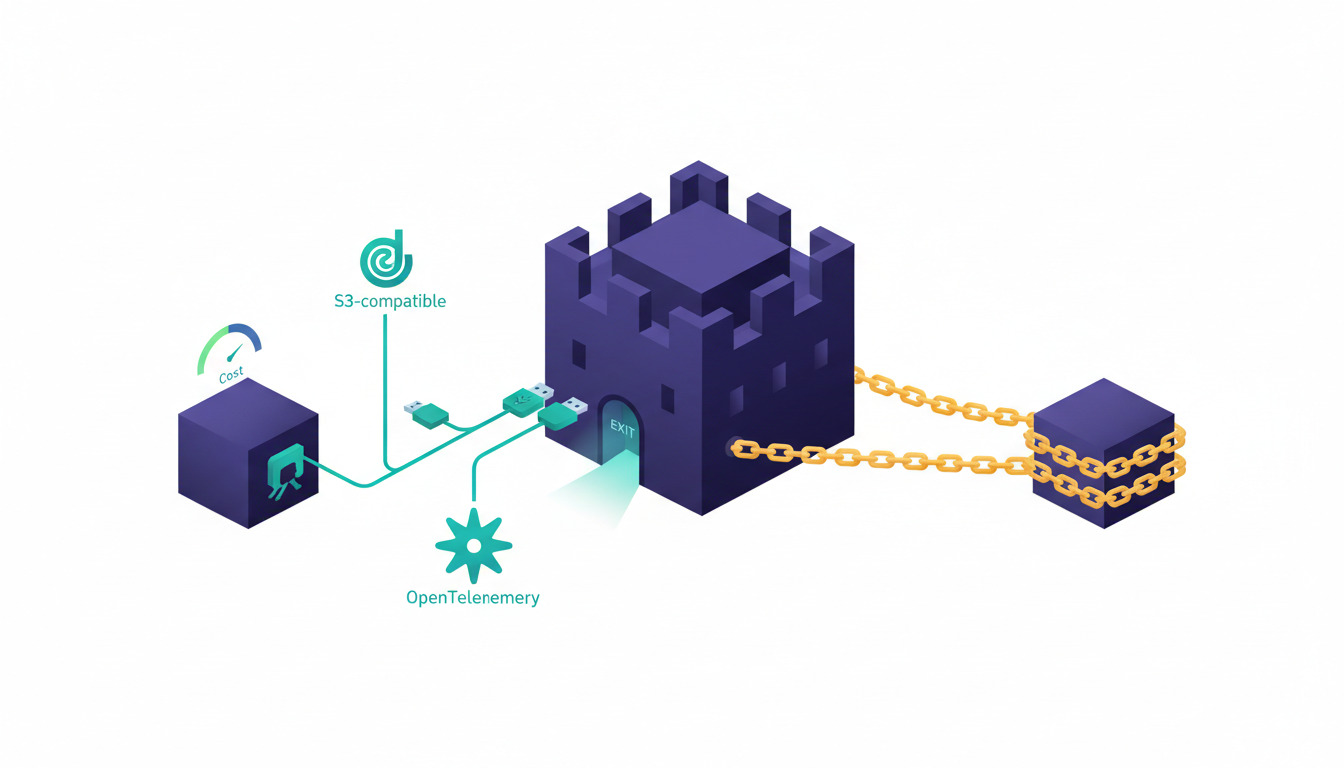
Vendor lock-in is the dependency tax you pay for picking the easy path. Whether it's an AWS-only database, a proprietary BaaS, or an AI platform with no portable model format, the cost shows up later — usually right when you most need flexibility. This guide explains what vendor lock-in actually means, how it builds up in real systems, and the practical patterns developers use to keep their options open.
What Is Vendor Lock-In?
Vendor lock-in is the condition where switching away from a provider — cloud, SaaS, database, AI platform, or framework — becomes so expensive, slow, or risky that you effectively can't. The lock isn't a contract clause. It's the accumulated weight of proprietary APIs, custom data formats, deep service integrations, and operational habits that don't transfer.
The classic textbook definition focuses on contract terms and switching costs. The practical engineering definition is more useful: vendor lock-in is anything in your architecture that you cannot replace within a reasonable budget and timeline. A managed PostgreSQL instance is barely lock-in. A serverless function tied to a proprietary event bus, IAM model, and managed runtime is severe lock-in — even if the function itself is twenty lines of code.
The three forms developers actually encounter
- Technical lock-in — proprietary APIs, custom query languages (DynamoDB, Cosmos DB), platform-specific services (Lambda, Cloud Run, Durable Functions), provider-bound identity and networking primitives.
- Data lock-in — egress fees, non-portable formats, vendor-specific extensions on otherwise standard tech (PostGIS vs Aurora-only features, Firestore documents vs vanilla MongoDB), and snapshot/restore formats that only the source platform can read.
- Operational lock-in — your team's runbooks, IaC modules, CI/CD pipelines, monitoring dashboards, and on-call muscle memory all built around one ecosystem. This is the form most engineers underestimate.
How Vendor Lock-In Develops
It almost never happens through a single decision. It accumulates through small, locally optimal choices that compound over years.
Proprietary APIs and runtime environments
Cloud providers ship managed services that solve real problems faster than the open-source equivalents. Each one creates a thread of dependency:
- Serverless runtimes — AWS Lambda, Azure Functions, and Google Cloud Functions have provider-specific event shapes, cold-start behaviour, and execution models. Code written against
event.Records[]doesn't run on Cloudflare Workers without a rewrite. - Identity and authorization — AWS IAM policies, Azure RBAC, and GCP service accounts are not portable. Auth code wired through SDK-specific credential chains has to be rebuilt for every target.
- Managed databases with proprietary extensions — Aurora's storage layer, Cosmos DB's multi-model APIs, and Firestore's real-time sync sit on top of (or instead of) standards. The closer you get to those proprietary features, the harder the exit.
Deep service integrations
A clean three-tier app starts portable. By month 18 it usually isn't. Common entanglement points:
- Provider-specific message buses (SNS/SQS, EventBridge, Pub/Sub, Service Bus)
- Managed AI/ML services (Bedrock, Vertex AI, Azure OpenAI) called directly from application code
- Object storage SDKs used without an abstraction layer
- CDN edge functions and origin shields glued to one provider's edge network
Operational and team lock-in
This is the form that bites hardest in a migration. Your engineers are fluent in CloudFormation, your dashboards live in CloudWatch, your incident runbooks reference AWS-specific concepts. Switching providers means re-training the team, rebuilding tooling, and accepting months of reduced velocity. The technology may be portable; the institutional knowledge is not.
Real-World Vendor Lock-In Scenarios
Database services: where lock-in hides in plain sight
Consider an application built on Amazon RDS for PostgreSQL. PostgreSQL is open source, so this looks safe. But:
aws_s3extension lets youCOPYdirectly to S3 — convenient, but not available anywhere else.- IAM database authentication ties auth flow to AWS credentials.
- Performance Insights and Enhanced Monitoring train your team to debug using AWS-only dashboards.
- RDS Proxy abstracts connection pooling in a way no other platform replicates exactly.
- Aurora-specific features (parallel query, fast clones, global database) cross the line from
managed PostgreSQL
intoproprietary product.
Migrating to a self-hosted PostgreSQL on a VPS — or to another provider — means rewriting any code that touched those extensions, rebuilding observability, and re-validating performance under a different I/O profile. If you set up zero-downtime deployments and proper database migration tooling early, the move is manageable. Without those, it's a multi-quarter project.
AI and ML: the new lock-in frontier
Vendor lock-in in AI infrastructure is moving faster than the cloud lock-in of the 2010s, and it's catching teams off guard:
- Model format lock-in — Bedrock, Vertex AI, and Azure OpenAI each expose models through proprietary endpoints with provider-specific token accounting, safety filters, and streaming protocols.
- Vector database lock-in — Pinecone, Weaviate Cloud, and provider-managed vector services use different indexing, filtering, and metadata models. Embeddings are portable; the retrieval layer often isn't.
- Accelerator lock-in — Committing to a single chip vendor (NVIDIA H100/B100 on AWS vs Google TPUs vs AWS Trainium) shapes your training stack, your CUDA dependencies, and your fine-tuning workflow.
- Agent platform lock-in — Proprietary tool-calling formats, custom orchestration DSLs, and platform-specific memory APIs lock agent logic to a single runtime.
The portable defaults — OpenAI-compatible APIs, ONNX, GGUF, OpenTelemetry-style traces — exist but are easy to skip when a managed service is one button click away. Teams running AI coding agents in CI/CD often discover this only when they want to swap models mid-pipeline.
SaaS and BaaS layers
Backend-as-a-Service platforms (Firebase, Supabase Cloud, Amplify, Appwrite Cloud, Base44) trade portability for time-to-market. Firestore documents, Realtime Database snapshots, Amplify DataStore models, and Supabase row-level security policies don't transfer to a vanilla Postgres + auth stack without a rewrite. The further you go into platform-specific features (Firebase Cloud Messaging, Amplify Studio, Supabase Edge Functions), the deeper the lock-in.
The Trade-Offs: When Lock-In Is Worth It
Vendor lock-in isn't categorically bad. The honest framing is a cost-benefit calculation.
When lock-in pays off
- Time-to-market matters more than optionality — pre-product-market-fit startups should ship, not engineer for hypothetical exits.
- The proprietary feature is genuinely differentiated — Aurora's storage layer, Cloud Spanner's consistency, or Bedrock's Claude integration may justify the dependency.
- The platform's ecosystem solves problems you don't want to solve — managed Kafka, managed Postgres, managed observability all reduce operational load.
When lock-in becomes a liability
- Pricing power shifts to the vendor. Egress fees, sudden price increases, or licence model changes can change the economics overnight.
- The provider deprecates a service. Google Cloud's track record alone is reason for caution.
- Regulatory or sovereignty requirements emerge. Data residency, sector-specific compliance (FedRAMP, GDPR, HIPAA), or geopolitical constraints can force a move on a schedule you don't control.
- Your scale crosses an economic threshold. Cloud is cheap until it isn't — see the Cloudflare R2 vs AWS S3 economics and the 37signals-style cloud exit movement for concrete examples.
For agencies and consultancies, this calculus is sharper still: client requirements change, contracts end, and projects get handed over. Picking a provider for your own internal reasons can become a liability when the client wants a different stack. Tooling like DeployHQ for agencies is built around that constraint — host wherever the client wants, deploy the same way every time.
Strategies to Minimise Lock-In
The goal isn't zero lock-in (that's neither possible nor desirable). It's keeping the exit cost bounded — knowing roughly what a migration would take, and making sure that number doesn't quietly explode.
1. Standardise on open interfaces where it matters
- Containers over functions — Dockerised workloads run anywhere. Serverless functions don't.
- PostgreSQL or MySQL over proprietary databases — both run unmodified on every major cloud, on VPSes, on your own hardware.
- Kubernetes (or a meaningful subset) — overkill for small teams, but the API surface is portable. For most teams, plain VPS deployments with Docker container deployment hit the same portability goal with less operational cost.
- OpenTelemetry over vendor agents — instrument once, route to whichever backend you use today.
- S3-compatible object storage — Cloudflare R2, Backblaze B2, MinIO, and Wasabi all speak the S3 API.
2. Build a thin abstraction layer for vendor calls
Not a full hexagonal architecture for every dependency — that's over-engineering. Just enough of an interface that the provider-specific SDK lives in one file:
# storage.py — one place that knows about the provider
from abc import ABC, abstractmethod

class ObjectStore(ABC):
    @abstractmethod
    def put(self, key: str, body: bytes) -> None: ...

    @abstractmethod
    def get(self, key: str) -> bytes: ...


class S3Store(ObjectStore):
    def __init__(self, client, bucket: str):
        self._client = client  # boto3, R2, MinIO, Wasabi — all S3-compatible
        self._bucket = bucket

    def put(self, key, body):
        self._client.put_object(Bucket=self._bucket, Key=key, Body=body)

    def get(self, key):
        return self._client.get_object(Bucket=self._bucket, Key=key)["Body"].read()
This isn't elegant architecture for its own sake. It's a measurable reduction in exit cost — when you want to swap providers, you change one file, not fifty.
3. Apply the 3-2-1 rule to your critical data
The 3-2-1 backup rule (three copies, two storage media, one off-site) is a hedge against operational failure. The same shape works against vendor lock-in: keep at least one full export of your critical data in a portable format — pg_dump, Parquet, plain JSON — in storage you control. If a vendor disappears tomorrow, you have a usable starting point.
4. Measure your exit cost annually
Pick a representative service in your stack. Estimate, in engineering-weeks, what it would take to move it to a different provider. Write it down. Compare next year. If the number is doubling year-over-year, you have a lock-in problem worth addressing now, while it's still cheap.
5. Use deployment automation that doesn't care where you deploy
Provider-specific CI/CD (CodePipeline, Cloud Build, Azure DevOps) is convenient but reinforces lock-in. A platform-agnostic Git deployment automation layer lets you point the same pipeline at AWS today, a self-hosted VPS tomorrow, and Cloudflare next quarter. Deploying from GitHub to your server or from GitLab the same way regardless of target turns switching provider
from a multi-quarter rebuild into a configuration change.
Ship the same way, anywhere. DeployHQ runs the same build, test, and deploy pipeline whether your server is in AWS, a hetzner box, or a client's data centre — no rewrites when you change providers. Try it free.
A Practical Evaluation Checklist
Before adding any new service to your stack, run through this:
- Standards check — does this service speak a standard protocol (S3, SQL, HTTP/REST, OpenTelemetry, OCI), or only a proprietary one?
- Data exit check — can you export everything in a portable format on demand? How long would a full export take?
- Migration mapping — write the one-paragraph version of
how would we move off this in twelve months?
If you can't, that's the answer. - Operational ownership — does your team know how to run the open-source equivalent if the managed service disappears?
- Cost trajectory — model the cost at 3× and 10× current scale. Is the pricing curve linear, or does it cliff?
- Contractual exit — egress fees, data-deletion timelines, minimum commitments, auto-renewal clauses.
- Sovereignty and compliance — does this service satisfy current and likely future regulatory requirements?
If the answer to most of these is we'd figure it out later,
you're accepting more lock-in than you probably realise.
Common Misconceptions
All vendor lock-in is bad
Not true. Some lock-in is the price of leveraging real platform value. The goal is to make the trade-off consciously, not to avoid every managed service on principle.
We'll just migrate if we need to
Sometimes. More often, later
is when the lock-in is at its worst — most data, most integrations, least free engineering time. The cheapest time to plan an exit is before you commit.
Multi-cloud solves this
Multi-cloud solves it only if you actually run the same workload on multiple clouds. Most multi-cloud
architectures are really single-cloud-per-service, which doubles the lock-in surface without doubling the optionality.
Open source means no lock-in
Open source reduces software lock-in but doesn't eliminate operational lock-in. Self-hosted Elasticsearch, Kafka, or PostgreSQL still requires ops capability your team may not have.
Warning Signs You're Locked In Deeper Than You Think
- Your last
what if we moved?
estimate is more than two years old, or never existed. - Adding a new region requires the provider's specific networking primitives.
- Your incident runbooks reference provider-specific dashboards by name.
- New engineers need provider-specific certifications to be productive.
- Quarterly costs are growing faster than usage, and you don't know exactly why.
- The provider's recent pricing or licence changes have already cost you real money.
Where Vendor Lock-In Sits in 2026
The economics have shifted. Storage and compute pricing pressure (visible in AWS's S3 Express One Zone price cuts and the cloud exit landscape) means more teams are revisiting decisions made when cloud-first was the default. AI workloads in particular have an unfavourable cost curve in managed cloud, which is why architecture-level decisions about portability now have a much shorter payback period than they did five years ago.
The teams who handle this best aren't anti-cloud, and they're not multi-cloud purists either. They treat vendor lock-in as one variable in an honest cost model — and they keep the exit cost bounded, year over year.
Key Takeaways
- Vendor lock-in is anything you cannot replace within a reasonable budget and timeline — not just a contract clause.
- It comes in technical, data, and operational forms. The operational form is the one teams underestimate.
- Lock-in isn't categorically bad. The goal is to make the trade-off consciously and keep the exit cost bounded.
- Standards (PostgreSQL, S3 API, OpenTelemetry, containers), thin abstraction layers, and platform-agnostic CI/CD are the highest-leverage hedges.
- Measure your exit cost annually. If the number is growing fast, address it while it's still cheap.
If you want a deployment pipeline that doesn't lock you to any one cloud — and works the same way whether you target AWS, a self-hosted VPS, or a client's hardware — DeployHQ's deployment platform is built for exactly that.
Questions about portable deployments or vendor lock-in trade-offs? Reach out at support@deployhq.com or @deployhq on X.