

How to manually add the automatic deployment webhook to GitHub
DeployHQ will automatically add a webhook to your repository so you can deploy your code from GitHub automatically, however if you've changed repository details you'll need add it manually.
Before you can add your webhook to GitHub, you'll need to retrieve it from your DeployHQ project.
Open your repository up in GitHub (there's a shortcut at the top of DeployHQ labelled "Browse Repository") and click the Settings tab at the top of the screen. Next click Webhooks on the left hand side, then Add webhook at the top:
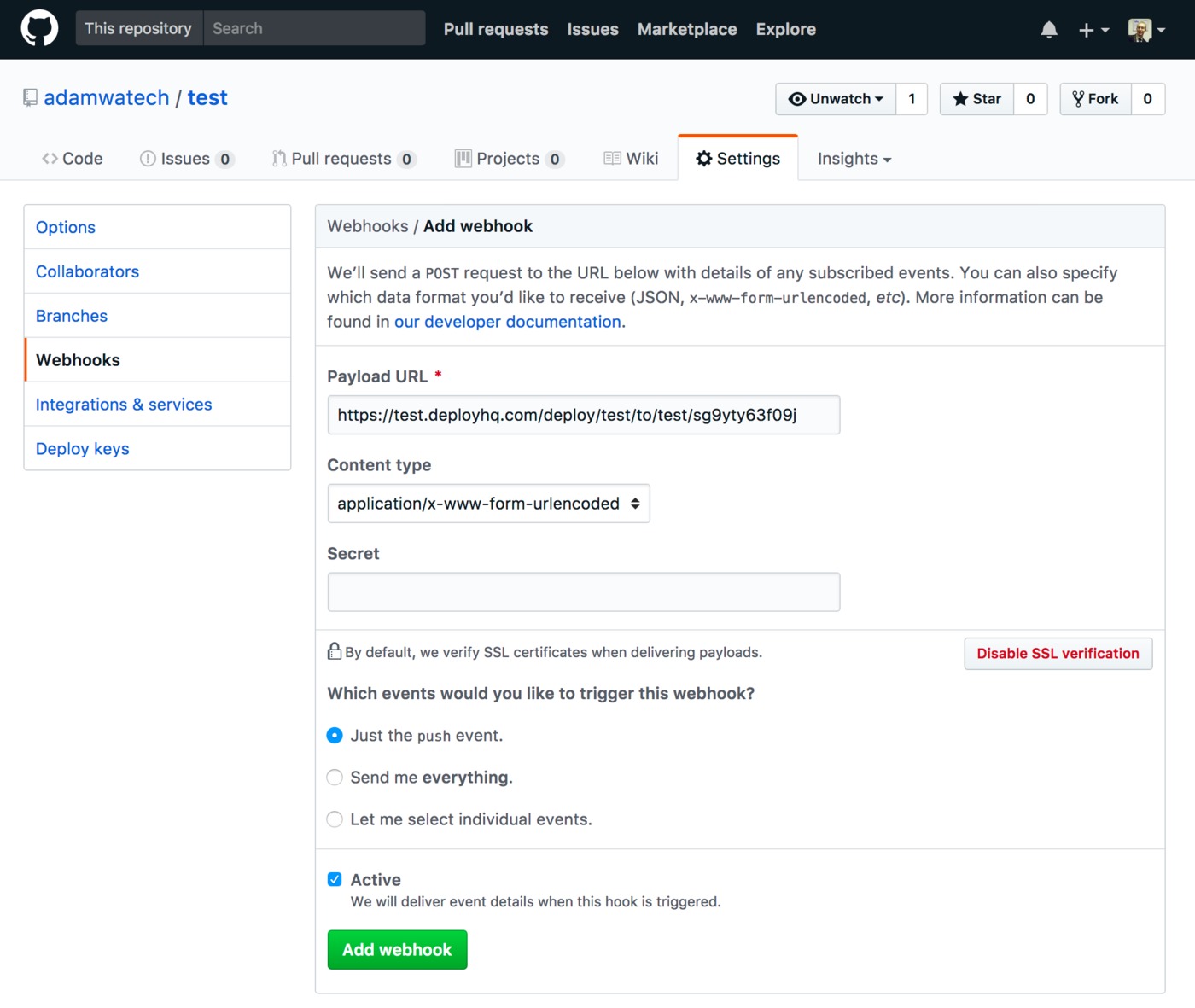
Enter the URL from DeployHQ into the Payload URL, select application/x-www-form-urlencoded as the Content type and hit Add webhook.
Verifying webhook payloads with the GitHub "Secret" field
GitHub's webhook configuration includes an optional Secret field, which, when set, causes GitHub to sign each payload with HMAC-SHA256 and send the signature in the X-Hub-Signature-256 request header.
By default, DeployHQ authenticates incoming webhook requests using the unguessable auto_deploy_key token embedded in the webhook URL itself — that token is what proves the request belongs to your project.
DeployHQ can also optionally verify the GitHub payload signature for an additional layer of security. This is useful if your organisation treats the URL-as-secret model as too weak (for example under SOC 2 or other compliance requirements), because the webhook URL can end up in git push logs, GitHub's webhook delivery history, screenshots, and support tickets. With signature verification enabled, a leaked URL alone cannot trigger a deployment without the signing secret.
Turning on signature verification
- In DeployHQ, open your project and go to Settings -> Automatic Deployments.
- In the Webhook secret field, enter a strong random secret and save it.
- In GitHub, open your repository's Settings -> Webhooks, edit the DeployHQ webhook, and enter the same value in the Secret field.
Once both sides share the secret, DeployHQ verifies the X-Hub-Signature-256 header (and the legacy X-Hub-Signature SHA-1 header, for older configurations) on every incoming webhook. Requests with a missing or incorrect signature are rejected with a 401 response, and the rejection is recorded in the Recently Received Hooks list on the Automatic Deployments page so you can diagnose a mismatch without contacting support.
Leaving the Webhook secret field blank keeps the existing URL-only behaviour — no existing webhooks are affected unless you opt in.
Notes
- Treat the webhook URL as a secret even with signature verification enabled — do not paste it into public issues, screenshots, or third-party services
- If you suspect a webhook URL has been exposed, contact support@deployhq.com to have a new URL issued for the project so the old one stops working
- GitLab webhooks can be verified the same way using GitLab's Secret token (sent as the
X-Gitlab-Tokenheader). Bitbucket Cloud does not sign webhook payloads, so signature verification is not available for Bitbucket repositories